Monday, March 31, 2008

work weekend


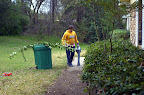
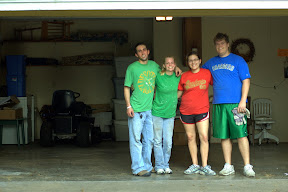
Their expressions say it all. We spent 20 hours of our weekend, cutting, cleaning, building, and repairing a family member's yard and house.

Ross and I built a new porch and hung new shutters:

Linds and Steph chopped down the jungle:

And we all worked to clean out the garage:

All in all, we filled 65 trash bags; trimmed 40 shrubs and 4 trees; clean out and organized 6 rooms and a garage; gave away 4 desks, 1 couch, 2 lamps, 5 chairs, 2 beds, 3 shelves, 30 books, 8 sets of sheets, 16 blankets, 1 chainsaw, 22 picture frames, 6 baskets, and 30 years of miscellaneous knick-knacks; hung 10 shutters; and built 1 porch.

Tuesday, March 18, 2008

dancing in beaumont


dance with the bride, originally uploaded by kab_live.

I shot my first dark indoor event this weekend. It was a learning experience. Mostly, I concentrated on lots of close shots of small groups and individuals...and some slower shutter shots on the dance floor.

Monday, March 10, 2008

left out


left out, originally uploaded by kab_live.

We spent the weekend @ the lakehouse in tyler. On Saturday, several of Linds' cousins showed up to celebrate my, and gpa Max's bdays. One of my favorite things to do out there is shoot baskets with the boys. Somehow, "big E" always ends up on the outside-looking-in...sometimes he gets his feelings hurt, but other times, I don't think he minds all that much. It's possible that he is instead, pondering the mysteries of the universe (or plotting revenge on his brothers).

Saturday, March 8, 2008

the co-existence of evil and the good God

Finishing Migliore's Faith Seeking Understanding and Grenz's Theology for the Community of God

The doctrine of a providential God has traditionally maintained that God provides, takes care of, supervises, enables, all things. If it has been understood that God is wholly good, and that He claimed his creation to be good, there is then conflict with the evil activity that is present in the world. This sin is experienced in two forms: natural evil, and malice. Natural evil refers to injury, suffering caused by diseases, accidents, earthquakes, tornados, fires, and floods, etc. Earthquakes and tornado are not in themselves evil, but when a person and tornado share identical location harm will result. Malice refers to evils preformed out of intentional or desired evil that involve moral or ethical judgments. Moral evil is a possible result when humans exercise their free will. If a person does not choose good, they choose against God; they choose evil.

Divine providence is less a speculative doctrine than a practical truth. Assuredly, there is a knowing and decided evil at work. Nevertheless, God reigns and evil is firmly under God’s control. Traditional theology has approached this quandary by several ideological methods. Many even choose to not attempt to explain how God can remain sovereign and good while the world is filled with evil. These, rest in the incomprehensibility of God; that all is a part of His providential plan, and that we should simply trust that God is good. Others have supposed that evil exist as the substance of divine punishment. This would include that both natural evil and malice are allowed, or even ordained by God, to punish the wickedness of mankind’s separation from the Creator. This concept would allow that humans today suffer both for the sins of Adam, as well as for their own individual sin. Other traditions hold a view of divine pedagogy that makes use of earthly suffering to turn us to God and to cultivate our hope for eternal life.

Migliore has described several serious modern concepts which have been rallied-around in explanation of the co-existence of God and evil. Some, having a very strong view of the sovereignty of God, have taken to a protest theodicy, believing that we are meant to struggle with the question of God’s goodness. It is necessary for people to engage themselves in the dilemma and honestly deal with “God is love”. The Bible presents several accounts of people genuinely seeking God’s provision in times of need. One such is the story of Jacob who was a man characterized by struggle. His struggle began while he was born clutching at his twin brother’s heel. When the time came, Jacob deceived his brother and his blind father and received the blessing of the first born. Fearing for his life, Jacob ran away from home for 20 years. A time came when Jacob was nearing a quarrel with his in-laws and so God instructed Jacob to return home. Jacob found himself stuck between possible danger with his in-laws and possible dangerous revenge from his own family. In his place of desperation and anxiety, he wrestled with God, begging for blessing (Genesis 31:1-33:11). In this experience he was faced with the realities of good and evil, and he would settle for nothing less than the good blessing of God. The key to Jacob’s experience and to the protest theodicy is to be faithful to God even when it might appear that God may not provide; and part of a faithful response to God is to protest evil.

Several modern scholars have instead supported a process theodicy, maintaining simply that God’s power is only expressed as persuasion, rather than coercion, thus He is limited and cannot prevent some evils. In this theory, God is indirectly responsible for evil because He creates forms of life that have the potential for evil. Though, God cannot be blamed because He intends good and He even shares in the suffering.

Out of the tradition of liberation theology has come a liberation theodicy which embraces redemptive suffering. There is “a call to courageous human participation in God’s struggle against suffering rather than a pious acquiescence in suffering.” Essentially believers are to cry-out as freedom fighters in a Christian war against sin.

I relate most, to the person-making theodicy. God desires “persons who freely render their worship and adoration. Hence, human beings are created incomplete and must freely participate in the process by which they come to be what God intends them to be.” There is biblical precedence for humanity's calling to submit ourselves to God; and this requires on our part, a full engagement of our physical, emotional, logical selves to our spiritual selves as we trust God, grow closer to Him relationally, and conform to His image. In this way we can begin to reach our full potential in Christ. I do though; agree with Migliore's description, in that the person-making theodicy is weakened by its lack of emphasis on resisting unnecessary suffering. In an extreme form, this type of ideology could lead people to actually seek out suffering, and in turn, could glorify suffering in itself. This is a pretty scary road if it is followed.

In essence, the reality of evil is the result of the freedom with which God endowed men. By giving mankind the freedom to choose him, God gave mankind the freedom to not choose him. God has said he is “The One forming light and creating darkness, causing well-being and creating calamity” (Isaiah 45:7). It is difficult for us to comprehend what is God’s place, and there may be many variations of explanation of how the Justice of God works out amidst the world’s sin. I tend to agree with those who understand God to be growing and shaping us to submit to Him more and trust Him more. In “Our quest for coherence, however, [we] must resist the temptation to build a system of ideas that pretends to know more than we do and thereby loses touch with both faith and lived reality. While we can have confidence in the truth of God revealed to us in Christ, our knowledge of God is not exhaustive” (Migliore). And so in some regard, I must simply trust that God is in control of all things, and that His goodness will be provided through the end of time. As well, I must engage myself in imitation and reflection of God’s good ways by being aware of evil and choosing to ask God for his provision of blessings, and by working against worldly evils as He give me strength. Through these efforts, I believe too, that God is working to conform me to the Imago Dei.


Friday, March 7, 2008

the effects of the Fall

The Effects of the Fall
I like what Stanley Grenz has to say about the effects of Adam’s sin. He surmises that through choosing to disobey God, Adam and Eve’s eyes were opened to the difference between good and evil. This created a break in the harmony in which they existed; which had been characterized by fellowship with God, community with each other, and living in accord with all other created things. Consequently, the first two of humanity introduced enmity that separates humankind from their Creator and from the rest of creation. Daniel Migliore defines this as evil, “which opposes the will of God and distorts the good creation.”

There could possibly be some spiritual-physiological aspect involved in the nature of human sin. Adam and Eve were created purely out of the power and creativity of God. Every human since then, has come about by an alternative experience. Without omitting God’s power in the process of reproduction, we all have been conceived and born out of the physiological substance of sinful humans. The first humans were derived only from God’s creativity and dust; since the fall, all others have come from cells. Though physiology may be only a theory, certainly, this break in community has culturally and spiritually been handed down since the fall. It has been taught by words and ideology, and by experiences, in such a way that we are essentially torn between the possibility of good and evil; and we continue to allow it to divide us. If God intended for us to exist in the unity of His image, the fall disfigured the human ability to live in such innocent harmony.

We are not punished by the actual event of Adam’s fall. Rather, his sin created the potential and inevitable future for us to imitate his sin; and we are punished for our participation in the break of God’s image. In this way, Adam’s fall represents all of humankind’s sin and guilt. What is for sure is that “the ills we experience do not arise from divine carelessness or impotence, but from a free and sinful human act” (Aquinas). Grenz suggests the possibility that in their innocence Adam and Eve had not had the opportunity to choose good (and God) over evil, and so they “did not yet fully participate in the human destiny as designed by God.” In this manner of reason, their sin has a two-fold effect; in that they both opened the door to discord, and to the opportunity to choose live in the harmonic image of God.

Thursday, March 6, 2008

the sin of humans and the providence of God

I was, at one time, romanced by the concept of the symbolic fall account, but struggled to connect my own original experience with Adam’s. His story began in an unspoiled paradise, while I was born into a world of sin. If the fall was merely symbolism of every human experience, then somehow I missed my opportunity to try out a sinless culture. I agree with the construct of Donald Bloesch, as described by Stan Grenz, in that “Adam is both actual and symbolic”. The Garden of Eden and the fall should be taken as historical and literal, and as the symbol and enablement of a sinful human tradition. Aquinas wrote that “The account of the Fall belongs to the history of salvation, even as does Genesis itself, and indeed the whole Bible…Facing the problems of man’s moral and physical situation at a certain point in Israel’s development, the author [of Genesis] proposed to give an account of human origins in accord with Israel’s faith in Yahweh’s concern for His people.” The story of the world’s first sin has not been held simply for the purpose of historicity. The sin of the first man is presented as the first of a whole series of faults which in the course of time have disfigured the work of God.

Tuesday, March 4, 2008

adam and eve-n me

Still reading the Grenz and Migliore books...but I'm staring a new one this weekend...I will be rereading "The Sabbatical Journey" (seems kind of appropriate). My readings from M and G this week dealt with humanity, and the sinful fall of Adam and Eve.

I was once romanced by the concept of the symbolic fall account (that the Genesis 3 story was a myth to symblize the sinful experience of humanity), but I struggled to connect my own original experience with Adam’s. His story began in an unspoiled paradise, and I was born into a world of sin. If the fall was merely symbolism of every human experience, then somehow I missed my opportunity to try out a sinless culture. I agree with the construct of Donald Bloesch, in that “Adam is both actual and symbolic”. The Garden of Eden and the fall should be taken as historica and literal, and as the symbol and enablement of a sinful human tradition.

I like what Grenz has to say about the effects of Adam’s sin. He surmises that through choosing to disobey God, Adam and Eve’s eyes were opened to the difference between good and evil. This created a break in the harmony in which they existed; which had been characterized by fellowship with God, community with each other, and living in accord with all other created things. As consequence, the first two of humanity introduced enmity that separates humankind from their Creator and from the rest of creation. This separation has culturally and spiritually been handed down since the fall. It has been taught by words and ideology, and by experiences, in such a way that we are essentially torn between the possibility of good and evil; and we continue to allow it to divide us. If God intended us to exist in the unity of His image, the fall disfigured the human ability to live in such innocent harmony.

Grenz suggests the possibility that in their innocence Adam and Eve had not had the opportunity to choose good (and God) over evil, and so they “did not yet fully participate in the human destiny as designed by God.” In this manner of reason, their sin has a two-fold effect; in that they both opened the door to discord, and to the opportunity to choose live in the harmonic image of God.
We are not punished by the actual event of Adam’s fall. Rather, his sin created the potential and inevitable future for us to imitate his sin; and we are punished for our participation in the break of God’s image. In this way, Adam’s fall represents all of humankind’s sin and guilt.